
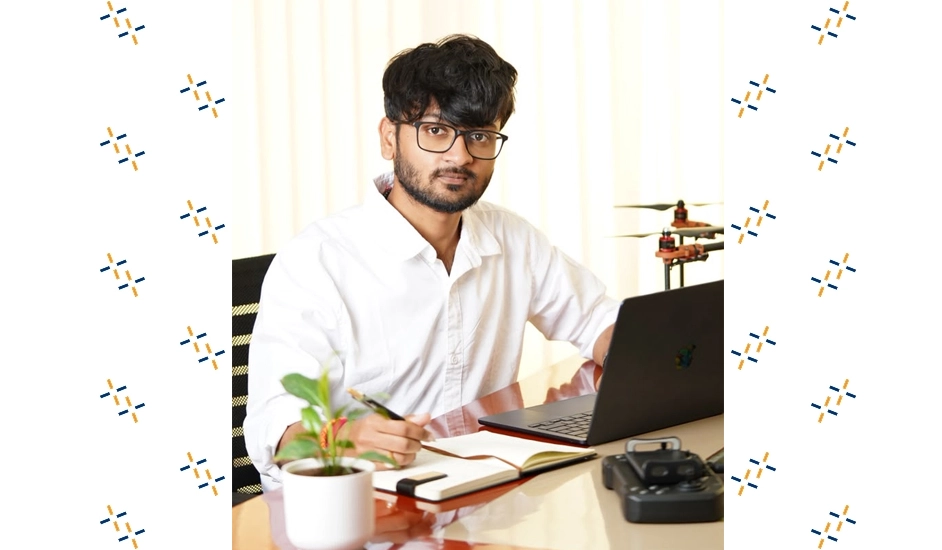
Ever since I was young, I have been fascinated by understanding how things work. I was the kind of person who would look beyond the finished product and wonder what was happening inside. Whether it was a gadget, a machine, or a simple electronic device, I always found myself wanting to understand the design, the components, and the thought process behind it.
As I grew older, that curiosity naturally led me towards engineering. During my academic journey, I spent much of my time building projects, experimenting with technology, and turning ideas into working prototypes. From smart vehicles and humanoid robots to AI-based systems and autonomous platforms, every project taught me something new. More importantly, they helped me realize that I enjoyed creating solutions and solving problems through technology.
My introduction to drone technology began with a simple question: what makes a machine fly and perform complex tasks in the real world? The more I explored, the more I understood that a drone is far more than a flying device. It is a combination of electronics, communication systems, embedded programming, sensors, aerodynamics, control systems, and software, all working together seamlessly. This realization sparked my interest in UAV systems, drone-based learning, and practical research and development.
What I had previously learned through books, videos, and personal projects could now be applied in a practical environment. My experience at Dronacharya Tech Hub allowed me to bridge the gap between theory and real-world application. Every day brought a new challenge. Some days involved integrating drone systems and configuring hardware, while others focused on troubleshooting issues, validating components, conducting flight tests, or preparing platforms for different use cases. Each task provided a deeper understanding of how reliable drone systems are designed, assembled, and operated.
One of the biggest lessons I learned through R&D is that progress rarely happens in a straight line. There are failed tests, unexpected issues, and moments when solutions take longer than expected. However, these experiences often become the most valuable learning opportunities. Through continuous testing and refinement, I learned the importance of patience, attention to detail, and approaching challenges with a practical mindset. This hands-on approach to research and innovation helped me develop the problem-solving skills that every engineer needs.
Working with the Vikas R&D Kit further strengthened my understanding of drone systems. Building a drone from individual components offers a completely different perspective compared to flying a ready-made platform. It helps you understand the role of every component, how different subsystems interact with one another, and why proper integration is critical for achieving stable and reliable performance. The Vikas R&D Kit encouraged experimentation, testing, and innovation, making it an ideal platform for students interested in drone development, UAV research, and advanced engineering projects.
Another part of my journey has been contributing to drone training programs, workshops, and hands-on learning sessions. Interacting with students, enthusiasts, and aspiring drone professionals has shown me how powerful practical learning can be. Explaining concepts, demonstrating systems, and helping others understand drone technology has not only allowed me to share knowledge but has also strengthened my own understanding. Teaching often challenges you to look at problems from different perspectives, and that has been a valuable learning experience in itself.
Through these workshops and training programs, I have seen firsthand how drone-based learning can transform the way students approach technology. When learners are given the opportunity to build, test, and fly drones themselves, concepts that seem complex in a classroom become much easier to understand. This practical exposure is what makes modern drone education so effective.
Looking back, I can see how a simple interest in understanding technology gradually evolved into a passion for building, testing, integrating, and working with advanced systems. The journey has been shaped by practical experiences, mentorship, challenges, and countless hours spent learning through hands-on work. Working in environments focused on R&D and innovation has shown me the value of experimentation and continuous improvement.
One aspect that particularly inspired me was seeing how dedicated drone labs and innovation centers create opportunities for students to explore real-world engineering challenges. These environments encourage collaboration, creativity, and technical growth while allowing learners to work on meaningful projects that extend beyond textbooks.
Drone technology continues to evolve rapidly, creating opportunities that were once difficult to imagine. From autonomous navigation and aerial intelligence to AI-powered applications and industrial solutions, drones are becoming increasingly important across multiple sectors. I am grateful to be part of this field and excited about what lies ahead.
Every project, flight test, integration challenge, and training session has contributed to my growth as an engineer. The experiences I have gained through Dronacharya Tech Hub and the Vikas R&D Kit have strengthened my technical skills, broadened my perspective, and reinforced my desire to continue developing technologies that make a meaningful impact.
For me, this journey has never been just about drones. It has been about learning, building, improving, and constantly pushing myself to understand what is possible. It has been about embracing innovation, contributing to R&D, and helping others discover the potential of drone technology through practical learning experiences. And in many ways, I feel that this is only the beginning.