
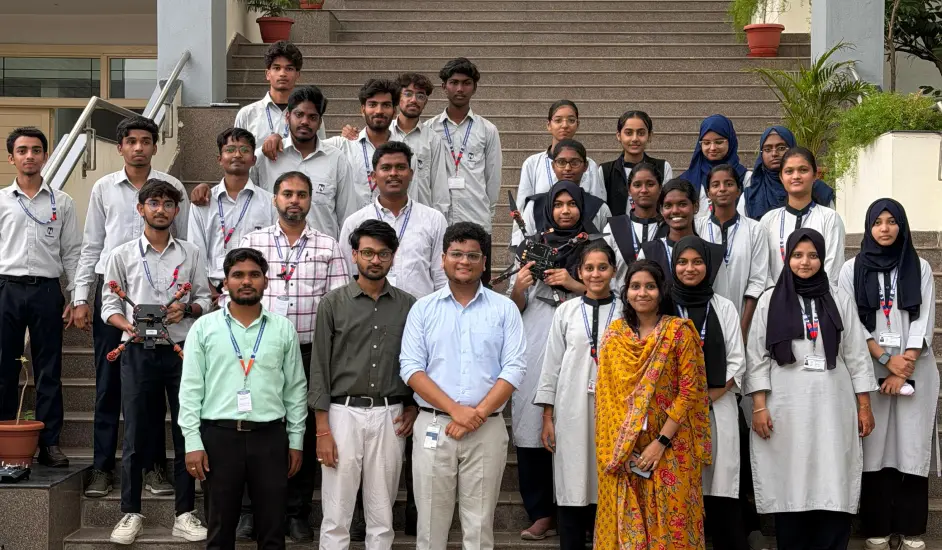
Drone technology is no longer limited to specialised laboratories or industry applications. Today, students and educators are increasingly exploring UAVs to understand electronics, programming, mechanical systems, embedded technology, automation, and research and development.
To bring this hands-on approach to engineering education, Dronacharya Tech Hub conducted a three day drone workshop at Navodaya Institute of Technology, Raichur, led by our team members Harshit Ukoti and Shaik Janulabdin.
The workshop was designed to take students and faculty beyond theoretical knowledge and give them a complete, practical understanding of how drones work, from assembling a drone to flying it and eventually developing their own R&D projects.
From Understanding Drones to Building One
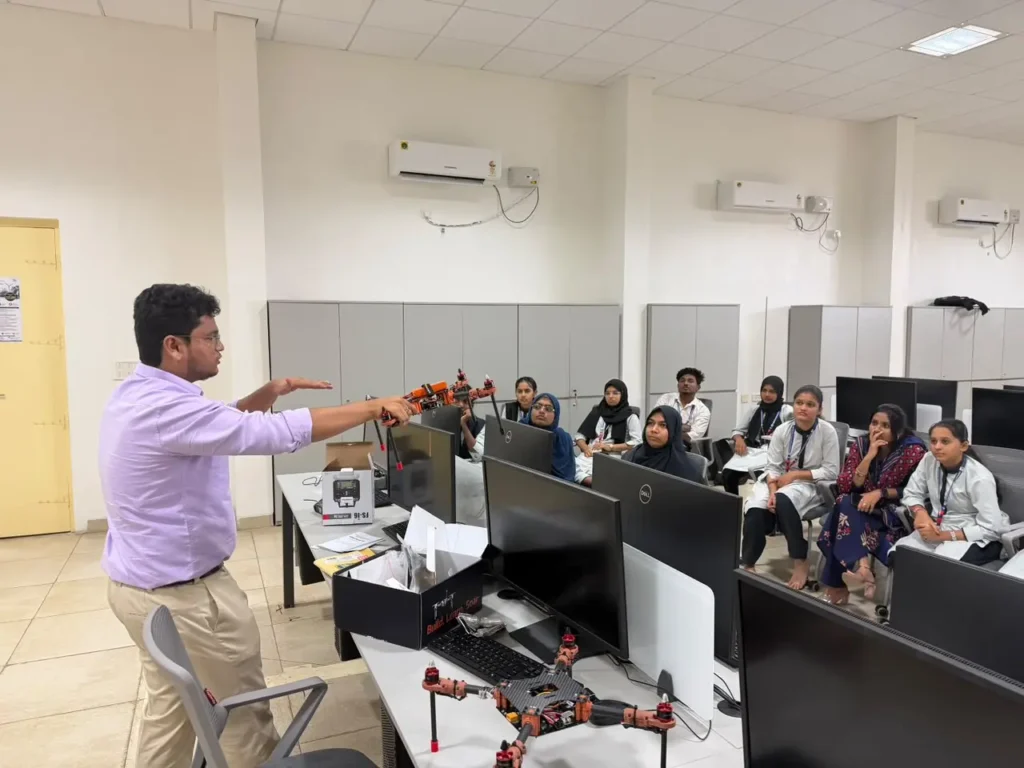
The workshop began with the fundamentals of drone technology and UAV systems. Introduction to drone technology and UAV systems Students and faculty were introduced to drone technology and UAV systems Rather than simply learning about drones through presentations, the participants engaged directly with the hardware. They explored the process of assembling a drone and understood the role of key components such as the frame, motors, electronic speed controllers, flight controller, GPS, power systems, and communication systems. The objective was simple: learn by building.
By the end of the assembly process, students had not just studied a drone, they had actively participated in building one.
A Complete Hands-On Drone Training Experience
The three day drone training program covered the complete journey from assembly to flight.
Students and faculty were introduced to:
- Introduction to drone technology and UAV systems
- Drone components and their functions
- Practical drone assembly
- Flight controller setup and calibration
- Pre-flight checks and flight preparation
- Practical flight testing
- Drone operation and flight experience
- Fundamentals of drone-based R&D
- Integration of electronics and computing platforms
The workshop followed a project-based learning approach, allowing participants to understand how theoretical concepts translate into real world engineering applications.
This hands-on approach is at the core of Dronacharya Tech Hub’s drone-based learning ecosystem, which focuses on helping students, educators, and institutions move from theory to practical UAV development.
Students Built Their Own Drone, and Then Flew It!
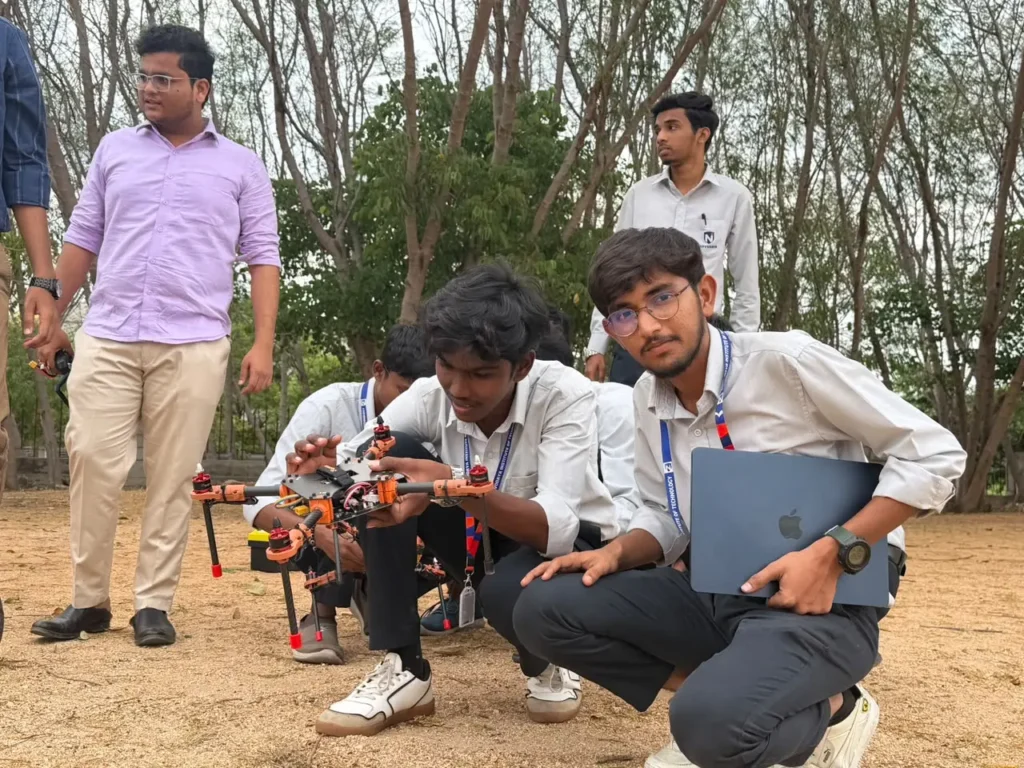
One of the most exciting moments of the workshop was when the students got the opportunity to fly the drones they had assembled themselves.
For many participants, this was more than just a flight test. It represented the complete engineering cycle:
Understand → Assemble → Calibrate → Test → Fly
This is what makes practical drone learning so powerful. Students are able to see the immediate outcome of their work and understand how different engineering disciplines come together in a single UAV system.
The experience also helped students develop confidence in working with real hardware, troubleshooting systems, and understanding the relationship between mechanical assembly, electronics, software, and flight control.
Moving Beyond Flying: Introduction to Drone R&D
While learning how to fly a drone is an important part of UAV education, the real possibilities begin when students start asking: “What else can I make this drone do?”
The workshop introduced students to the fundamentals of Drone R&D, showing them how a drone can be used as a platform for experimentation and innovation.
Participants explored how additional hardware, software, and communication systems can be integrated into a UAV to develop new applications.
Two of the key project concepts explored during the workshop included:
Raspberry Pi Integration
Students were introduced to the possibilities of integrating a Raspberry Pi with a drone system.
A companion computer such as the Raspberry Pi can enable students and researchers to explore advanced applications such as:
- Computer vision
- AI-based systems
- Autonomous decision-making
- Sensor integration
- Data processing
- Robotics applications
This gives students a pathway from basic drone assembly to advanced UAV development and autonomous systems research.
Servo Integration Using Arduino and MAVLink
Another project explored the integration of a servo mechanism using Arduino and MAVLink.
This introduced students to the concept of connecting external mechanisms and hardware to a drone platform. Such integrations can form the foundation for projects involving payload mechanisms, automation, custom actuation systems, and other innovative UAV applications.
The use of platforms such as Arduino and communication protocols such as MAVLink enables students to understand how drones can become more than flying machines, they can become adaptable engineering platforms for research and development.
The modular approach of Dronacharya Tech Hub’s UAV learning platforms is designed to support exactly this kind of experimentation, including integration with companion computers, sensors, electronics, and research hardware.
Faculty Engagement Is Just as Important
The workshop saw enthusiastic participation not only from students but also from the faculty members at Navodaya Institute of Technology. For drone education to create a long term impact, faculty members play a crucial role. When educators understand UAV technology and gain practical experience with drone hardware, they can continue guiding students through future projects, experiments, and research initiatives.
A strong drone learning ecosystem is therefore not limited to a one time workshop. It creates the foundation for continued innovation within an institution.
This is why Dronacharya Tech Hub works with educational institutions to empower Faculty through faculty development program that includes hands-on drone training, understanding of UAV technology & the curriculum methodology. Our institutional programs include drone kits, structured training, practical flight modules, project-based learning, and support for setting up dedicated drone laboratories.
Building the Future of UAV Education
The three-day workshop at Navodaya Institute of Technology, Raichur, demonstrated the impact of hands-on learning.
Students were able to:
- Understand the fundamentals of drones and UAVs
- Assemble a functional drone
- Learn the importance of calibration
- Conduct flight tests
- Fly a drone they had built
- Explore Projects of different varieties
- Discover the possibilities of drone R&D
Most importantly, the students and faculty showed a keen interest in continuing to explore the possibilities of UAV technology.
This enthusiasm is exactly what the future of engineering education needs.
Why Hands-On Drone Learning Matters
The drone industry is rapidly expanding across sectors such as agriculture, infrastructure, defence, logistics, surveillance, disaster management, research, robotics, and automation. However, the growth of the industry also creates a need for engineers and innovators who understand how UAV systems actually work.
A student who learns how to build a drone gains more than the ability to fly it. They begin to understand:
- How motors generate thrust
- How flight controllers stabilise a UAV
- How sensors provide data
- How communication systems control a drone
- How software interacts with hardware
- How external systems can be integrated
- How to convert an idea into an R&D project
This is the difference between simply operating a drone and understanding the technology behind it.
From DIY Drone Kits to Advanced UAV Research
The right drone kit can make UAV education accessible to students at different levels.
A beginner can start by learning the fundamentals of assembly and flight. As their understanding develops, they can move towards sensors, embedded systems, companion computers, automation, and autonomous applications.
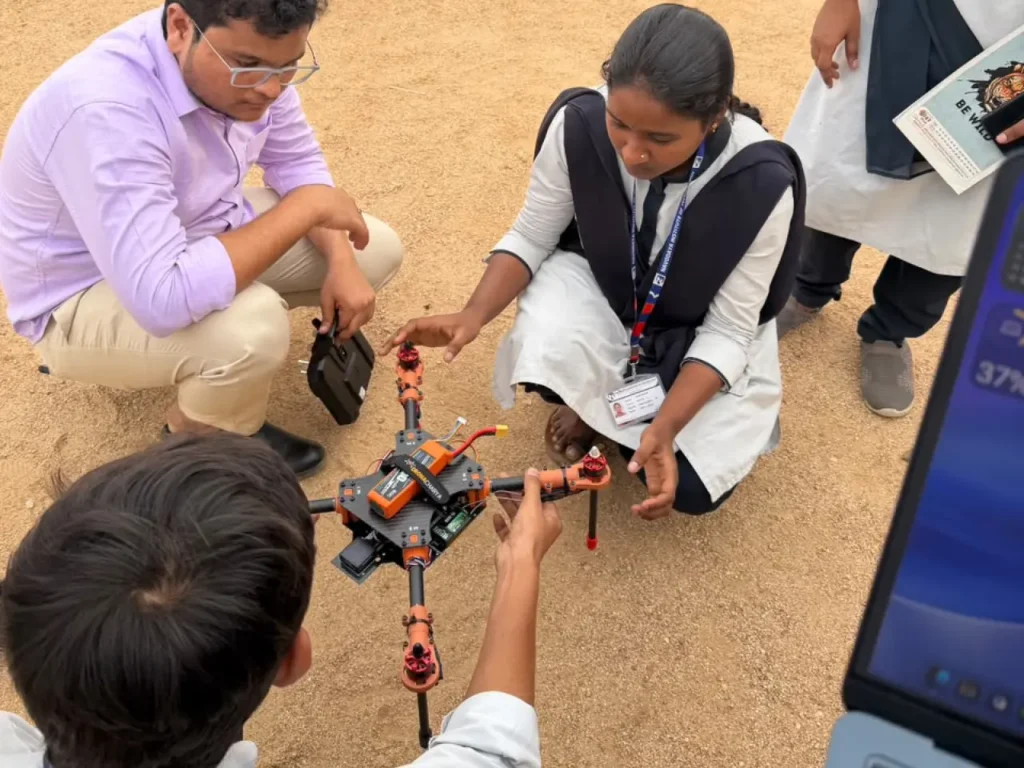
This is the philosophy behind Dronacharya Tech Hub’s modular UAV learning platforms. These platforms are designed to support hands on learning, UAV experimentation, prototyping, sensor integration, and student-led projects.
A DIY drone kit can therefore become more than a collection of components. It can become a complete learning platform where students can:
Build a drone → Understand the technology → Experiment with hardware → Develop projects → Innovate
Dronacharya Tech Hub: Enabling the Next Generation of UAV Innovators
At Dronacharya Tech Hub, we believe that the best way to learn drone technology is to experience it firsthand. From understanding the basics of UAVs to assembling a drone, from conducting the first flight test to developing R&D projects, practical exposure can transform the way students approach technology.
Our work with institutions like Navodaya Institute of Technology, Raichur, is part of a larger mission: to make drone learning accessible, practical, and innovation-driven.
Through drone workshops, drone training programs, and project-based learning support, Dronacharya Tech Hub is helping educational institutions prepare students for the future of unmanned systems.
Because the future of drones will not be built by people who only know how to fly them.
It will be built by the students who understand how to build, modify, integrate, experiment, and innovate. And that journey begins with hands-on learning.
Want to Bring Hands-On Drone Learning to Your Institution?
Dronacharya Tech Hub works with schools, colleges, universities, and institutions to deliver practical drone workshops, drone-based learning programs, R&D experiences, and complete drone lab solutions.
If your institution wants to help students learn how to build a drone, understand UAV technology, and develop real-world R&D projects, get in touch with the Dronacharya Tech Hub team.