
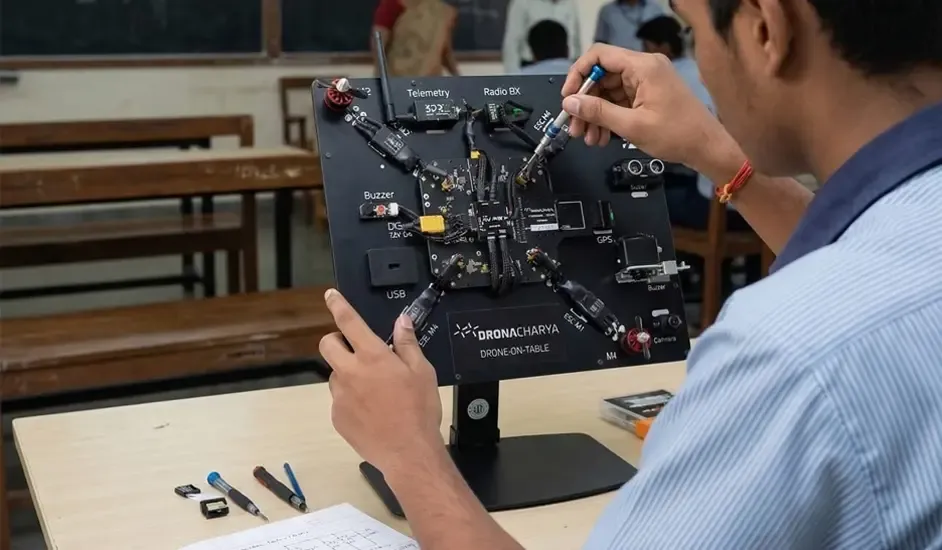
As drones continue to transform industries ranging from agriculture and surveying to logistics and defense, educational institutions are rushing to establish drone labs and drone training centers on campus. Yet, surprisingly, many of these labs fail to deliver meaningful outcomes before they even get off the ground.
The reason isn’t budget.
It’s because institutions often focus on purchasing hardware without building a complete ecosystem for learning, innovation, and research.
At Dronacharya Tech Hub, we’ve worked with colleges, universities, and training institutions across India to create drone labs that don’t just teach students how to fly a drone, they teach them how to build, innovate, research, and solve real world problems using UAV technology.
The Foundation of Every Successful Drone Lab: The Right Hardware
Many drone labs begin with commercial drones that are designed to fly, not to teach.
Students may learn basic flight operations, but they rarely understand what happens inside the drone. As a result, opportunities for research, innovation, and product development are lost.
That’s why we developed the Vikas Drone Kit. A research-grade DIY drone kit specifically designed for learning and experimentation.
Unlike traditional drone kits, the Vikas Drone Kit features:
- No soldering required
- Snap-and-fly assembly
- Open-source PCB architecture
- Intuitive design for beginners
- Classroom-friendly assembly process
- Research and development focused learning
Students can quickly learn how to build a drone without getting stuck in complex soldering processes. Instead of spending hours on assembly challenges, they can focus on understanding flight systems, electronics, communication protocols, sensors, and UAV architecture.
Whether you’re introducing students to drone technology for the first time or enabling advanced UAV research, the Vikas Drone Kit provides the ideal platform.
Beyond Flying: Teaching Students How Drones Actually Work
Learning how to fly a drone is important, but it is only one part of the drone ecosystem.
The future drone workforce needs engineers, researchers, developers, and innovators who understand:
- Flight controllers
- Drone electronics
- UAV communication systems
- Sensors and payload integration
- Autonomous flight systems
- AI-powered drone applications
- GIS and mapping technologies
- IoT-enabled drone solutions
This is where structured drone training becomes critical.
A successful drone lab should help students understand the complete lifecycle of drone development, from concept and design to assembly, testing, flight, and deployment.
How to Fly a Drone for the First Time: Turning Beginners into Innovators
One of the most common questions students ask is:
“How do I fly a drone for the first time?”
While flight training is important, a quality drone education program goes much deeper.
Students should learn:
- Drone safety fundamentals
- Pre-flight inspection procedures
- Flight controller basics
- UAV regulations and compliance
- Manual and assisted flight modes
- Troubleshooting techniques
- Mission planning and execution
At Dronacharya Tech Hub, these concepts are integrated into our curriculum so students gain both theoretical and practical experience. The goal is not simply to teach students how to operate a drone but to help them understand the engineering behind every flight.
DIY Drone Kits: The Future of Hands On Drone Learning
The demand for DIY drone kits has grown significantly as educational institutions recognize the importance of experiential learning.
Building a drone from scratch provides students with valuable skills in:
- Electronics
- Aerodynamics
- Embedded systems
- Mechanical design
- Programming
- System integration
The Vikas Drone Kit simplifies this journey through its no-soldering design while still exposing students to the core engineering principles behind UAV systems.
Students gain confidence because they are actively building, testing, and modifying their drones rather than simply using pre-built systems. This hands-on approach significantly improves knowledge retention and encourages innovation.
A Curriculum Built Around Innovation, Not Memorisation
Many drone labs struggle because they rely on generic presentations and disconnected theory sessions.
A successful drone program requires a structured curriculum aligned with practical outcomes.
At Dronacharya Tech Hub, our drone lab ecosystem combines:
Drone Design and Assembly
Students learn how to build a drone and understand every subsystem involved in UAV development.
Drone Flight Training
Practical modules teach how to fly a drone safely and confidently.
Research and Development Projects
Students use drones as a platform for innovation rather than simply operating them.
Emerging Technology Integration
Projects include:
- Artificial Intelligence (AI)
- Machine Learning (ML)
- Geographic Information Systems (GIS)
- Internet of Things (IoT)
- Computer Vision
- Autonomous Navigation
This project-based approach prepares students for real-world challenges and industry opportunities.
Train-the-Trainer: Building Faculty Capability
Even the best drone lab cannot succeed if faculty members lack confidence in operating and managing it.
This is why Dronacharya Tech Hub offers comprehensive Train-the-Trainer programs.
Faculty members receive:
- Drone technology training
- UAV assembly instruction
- Flight operations guidance
- Project mentoring support
- Research and innovation frameworks
The result is a self-sustaining drone ecosystem that continues delivering value long after installation.
Complete Drone Lab Setup Support
A drone lab is much more than a room filled with equipment.
A successful setup requires:
- Hardware selection
- Curriculum design
- Faculty training
- Research mentorship
- Innovation support
- Student project guidance
- Industry alignment
Dronacharya Tech Hub provides end-to-end drone lab setup services that help institutions establish future-ready UAV learning environments.
Preparing Students for the Future of UAV Technology
Drone technology is no longer a niche field.
Industries worldwide are hiring professionals with expertise in:
- Drone Operations
- UAV Research and Development
- Drone Mapping
- Precision Agriculture
- Industrial Inspection
- Autonomous Systems
- AI-Powered Drones
- Defense Technology
- Surveying and GIS
By combining drone training, hands-on assembly, project-based learning, and innovation-focused education, institutions can prepare students for these emerging opportunities.
Ready to Build a Drone Lab That Actually Delivers Results?
Most drone labs fail because they stop at hardware.
Successful drone labs create an ecosystem where students learn how to build a drone, how to fly a drone, develop real-world applications, and conduct meaningful research.
With the Vikas Drone Kit, structured drone training programs, Train-the-Trainer support, and complete drone lab setup solutions, Dronacharya Tech Hub helps institutions build future-ready UAV innovation centers.
Your institution’s drone lab is one demonstration away from becoming a hub for drone research, innovation, and next-generation technology development.