

Objective
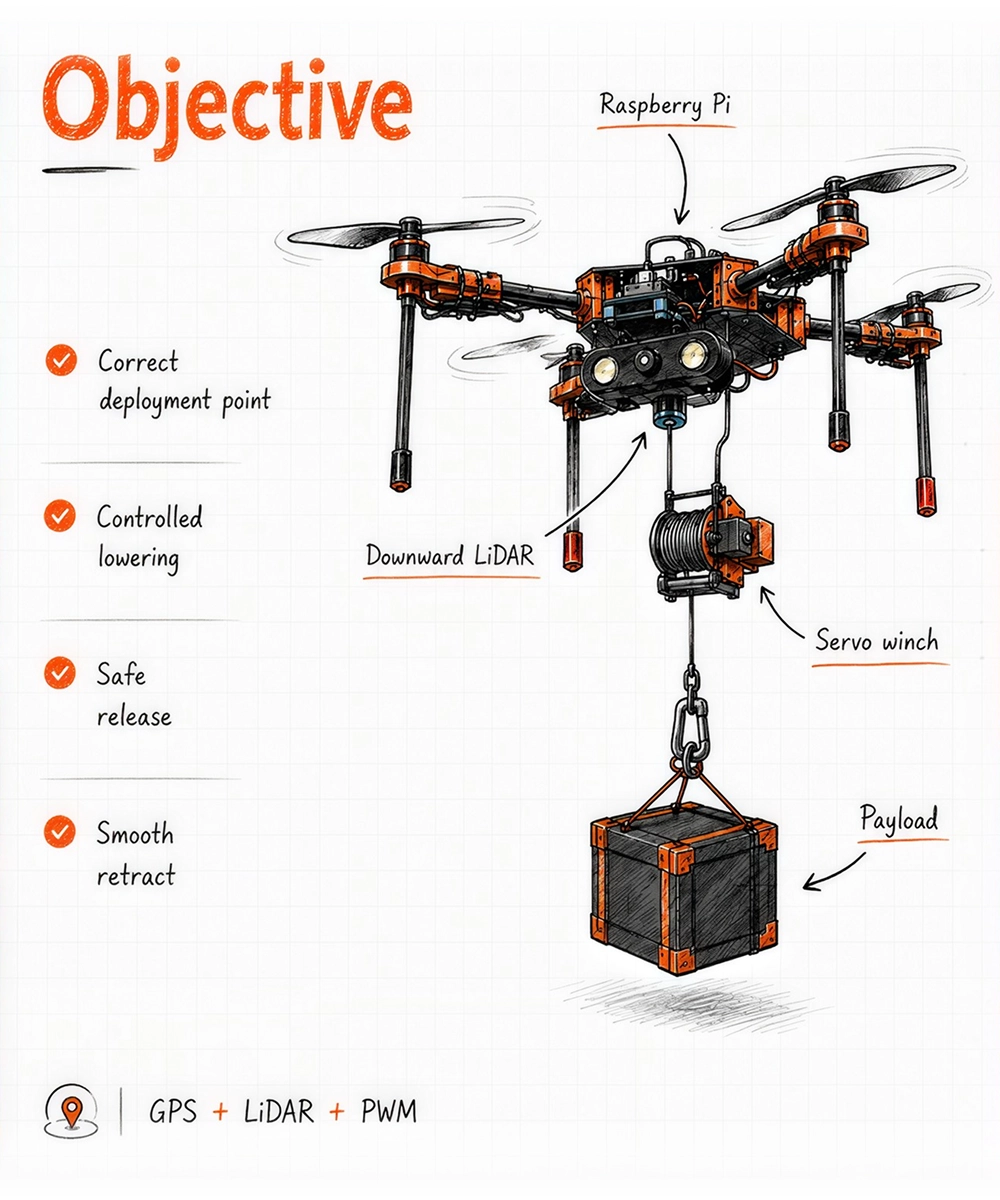
We developed an autonomous drone payload deployment system using a servo driven winch. While it initially seemed like a simple servo integration task, testing revealed the need for precise control to prevent cable jamming, over-rotation, and mechanical damage.
The system was designed to:
- Detect the correct deployment location
- Lower and release the payload safely
- Retract the winch smoothly
- Prevent servo and cable failures
Core components included a Raspberry Pi, downward-facing LiDAR, GPS positioning, a servo-driven winch, and calibrated PWM control.
Challenge
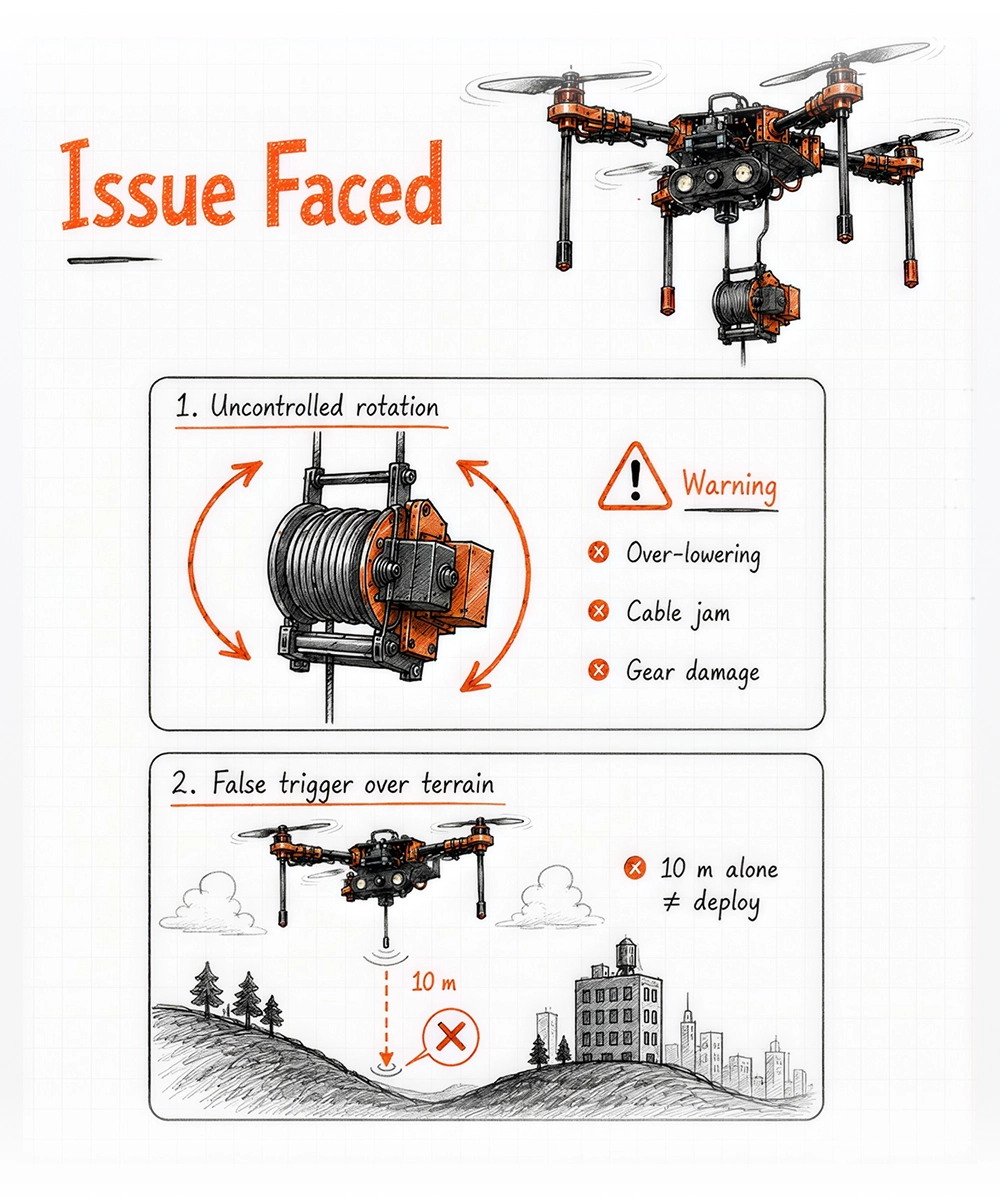
Two key issues emerged:
- Servo Control: A continuous-rotation servo kept winding the cable unless precisely controlled, risking payload over-lowering, cable tangling, and gear damage.
- Sensor Logic: Triggering deployment based only on LiDAR height was unreliable, as terrain variations (trees, rooftops, slopes, etc.) could produce the same height reading at the wrong location.
The real challenge became ensuring the drone was both at the correct GPS location and the correct altitude before deploying the payload.
Engineering Approach
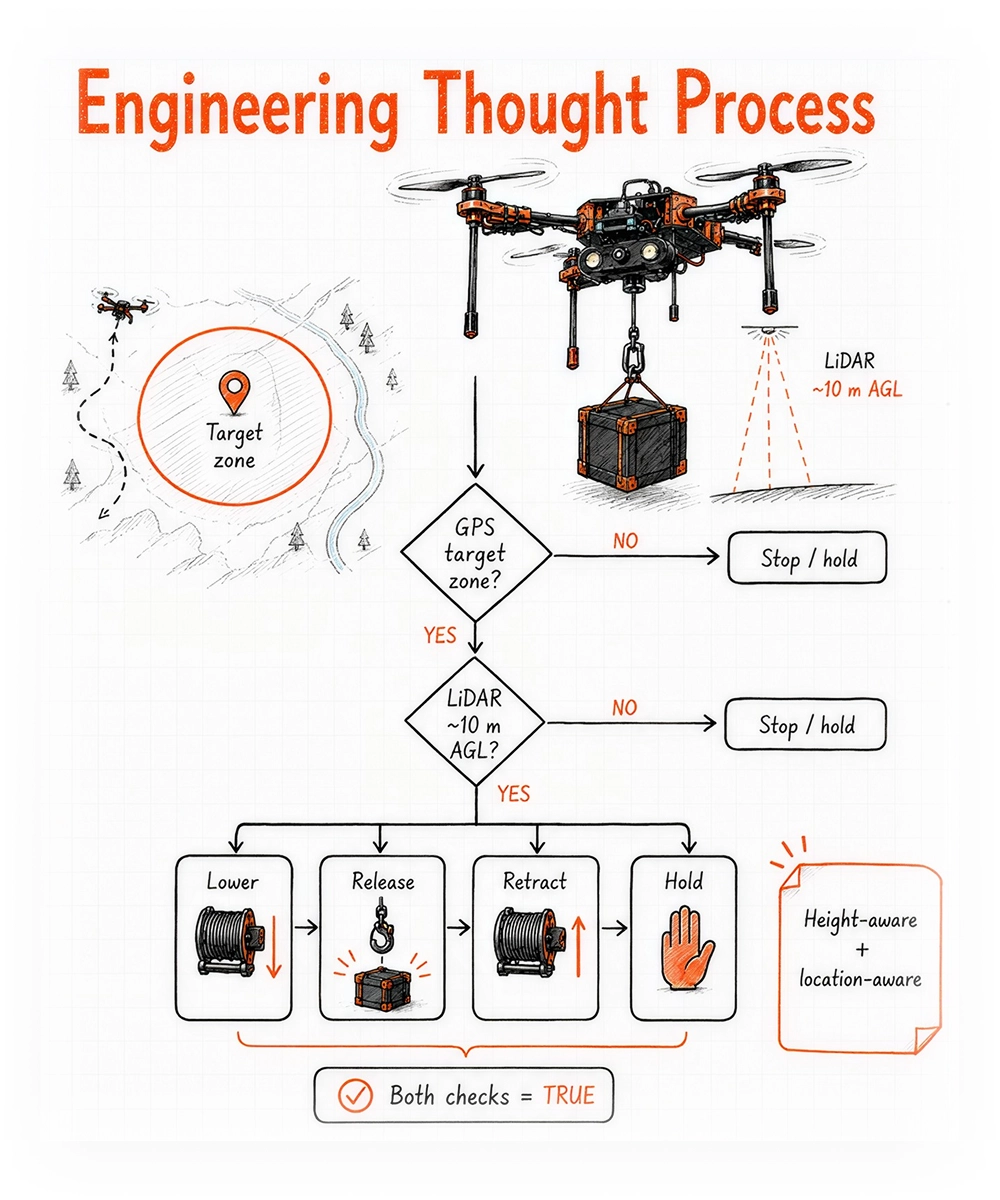
Instead of treating the servo as a simple actuator, we designed a mission-aware state machine.
The deployment sequence required two conditions:
- The drone must be within the designated GPS deployment zone.
- LiDAR must confirm the required height above ground.
Only after both checks passed did the Raspberry Pi execute calibrated PWM commands to lower the winch, release the payload, retract the cable, and stop the servo safely.
Solution
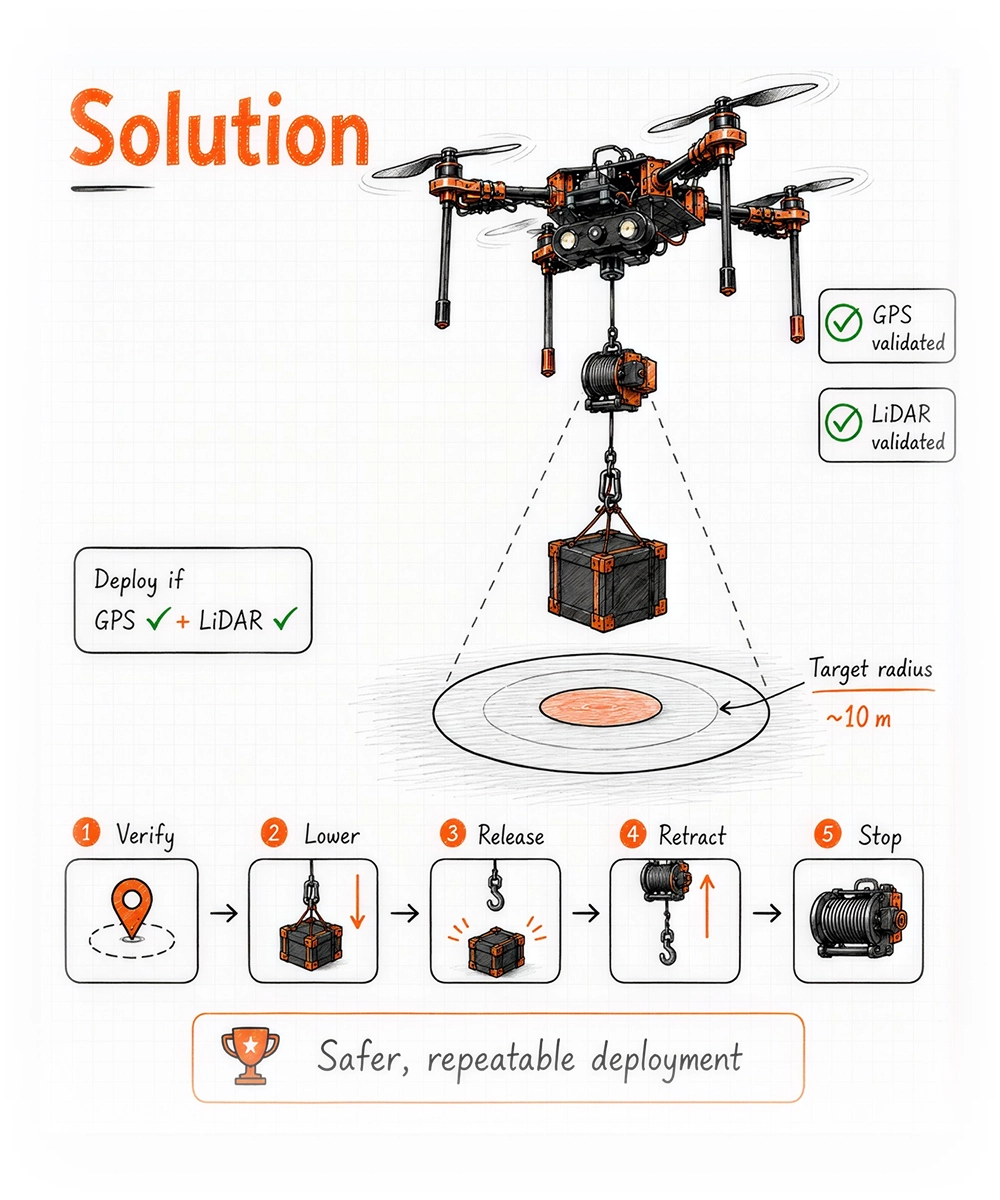
The final system followed a controlled sequence:
- Validate GPS position.
- Confirm deployment height using LiDAR.
- Lower the payload with calibrated PWM control.
- Release the payload.
- Retract the winch.
- Return the servo to a neutral state to prevent over-rotation.
This dual-validation approach made the deployment process accurate, repeatable, and reliable across different mission environments.
Engineering Learning
This project demonstrated that autonomous payload deployment is far more than connecting a servo to a flight controller. Reliable UAV integration requires combining sensor fusion, calibrated actuator control, mechanical constraints, and mission logic into a single autonomous subsystem. By treating the winch as a mission-critical component rather than a simple servo, we achieved a safer and more dependable payload deployment system.