
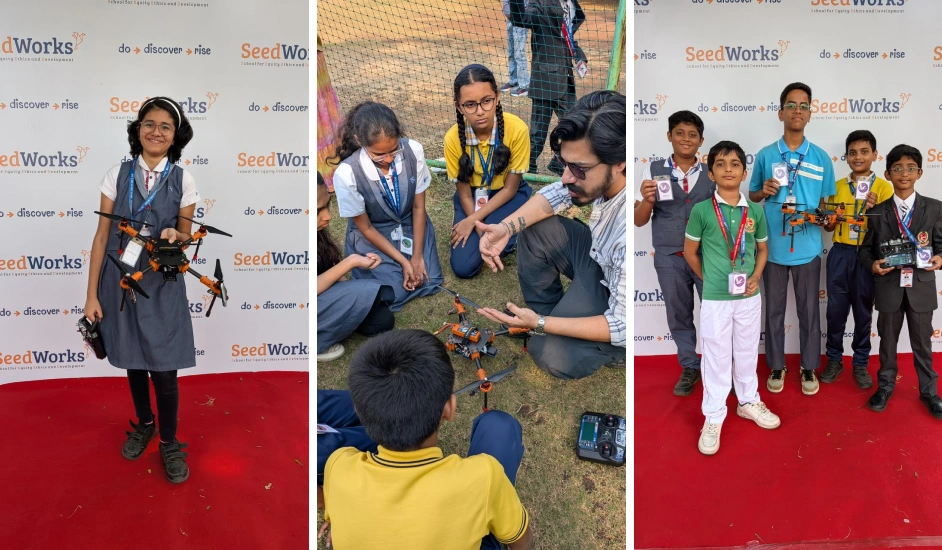
Ask a ten-year-old what a drone is, and you’ll likely get an excited answer. Ask them how it works, and you’ll often get a blank look. That gap, between fascination and understanding, is exactly where drone education in K-12 schools can make a difference.
Children today are growing up surrounded by drones, from wedding videos to farm fields to news footage. The question is whether they’ll remain spectators or become the people who understand, build, and improve this technology. The answer depends a lot on when they get started.
Curiosity Is Strongest Early
Young students ask “why” constantly. Why does it fly? Why does it tilt? Why does it fall when the battery runs out? A UAV answers these questions in a way a textbook diagram rarely can, because the result is visible right in front of them.
Hands-on drone learning takes that natural curiosity and gives it direction. Instead of memorizing definitions of lift, thrust, and gravity, students see these forces at work and begin to understand them intuitively. Concepts that feel abstract in a classroom suddenly feel real.
One Subject, Many Skills
One of the biggest strengths of drone education is that it isn’t a single subject. It pulls together several disciplines at once:
- Physics: how lift, thrust, balance, and air resistance work
- Mathematics: angles, measurements, speed, and distance
- Electronics: how batteries, motors, and controllers work together
- Coding and logic: how instructions translate into movement
- Design and engineering: how a structure is planned, built, and improved
For a school, this means a single drone kit can support lessons across STEM subjects, helping students see how they connect rather than treating each one as a separate box.
Building Confidence by Building Things
Most children don’t lose interest in science because it’s hard. They lose interest because it feels distant from anything they can touch. When a student gets to build a drone with their own hands, that changes.
A beginner-friendly DIY drone kit lets students assemble real components, make mistakes, fix them, and eventually watch their creation fly. That experience builds something no worksheet can: the confidence that “I can figure this out.” It teaches patience, careful thinking, and the habit of testing and improving, skills that carry into every subject and every career.
Teamwork and Problem-Solving Come Built In
Drone projects work well as group activities. One student handles assembly, another checks connections, another runs the pre-flight checks. When something doesn’t work, the team has to troubleshoot together.
This mirrors how real engineering and R&D Teams operate. Students learn to communicate clearly, divide responsibilities, and treat failure as information rather than defeat. These are the same habits that make adults effective at work, and they’re far easier to develop early.
Preparing Students for a Growing Industry
Drones and UAV technology are expanding across agriculture, mapping, logistics, infrastructure inspection, media, and disaster response. As these industries grow, so does the need for people who understand how the technology works, not just how to operate it.
Students who are introduced to drone technology in school have a long runway. By the time they reach college or enter the workforce, they’ve already had years of exposure to flight systems, electronics, and problem-solving. That head start can shape the courses they choose, the projects they take on, and the careers they imagine for themselves.
What Good Drone Education in Schools Looks Like
Not every program works equally well. Effective K-12 drone education usually has a few things in common:
- Age-appropriate progression. Younger students start with basic concepts, safe flying, and simple builds. Older students move toward calibration, programming, and R&D projects.
- Hands-on first. Students spend more time building and flying than listening to lectures.
- Safety built in. Clear rules, supervised flying, and proper pre-flight checks from day one.
- Teacher support. Faculty are trained alongside students, so the program continues long after a drone workshop ends.
- Accessible tools. A DIY drone kit designed for beginners means no prior experience is required from teachers or students.
Where Schools Can Start
Introducing drone education doesn’t require a large lab or a big budget. Many schools begin with a single drone workshop for a group of interested students, then expand into a club, a lab, or a full curriculum module as interest grows.
The important part is starting. Every year a student spends curious about drones, without a chance to build one, is a year of potential left unused.
Bring Drone Education to Your School
At Dronacharya Tech Hub, we design structured drone training programs, workshops, and drone kit based learning experiences for institutions at every level, from schools to colleges. If you’re a principal, coordinator, or educator who wants your students to learn by building, we’d love to help you get started.