
Ask most people where India’s next big drone startup will come from, and the answer is predictable: Bangalore, Hyderabad, Pune, maybe a top IIT. But after running drone workshops across institutions of all sizes, we at Dronacharya Tech Hub have noticed something that doesn’t fit that map.
Some of the most promising drone innovation we’ve seen isn’t happening in metro cities. It’s happening in Tier-2 and Tier-3 colleges, where students are hungry, curious, and just waiting for the right exposure.
The Old Innovation Map Is Changing
For years, technology careers in India followed a familiar path: study in a big city, work in a bigger one. Resources, mentors, labs, and industry exposure were concentrated in a handful of places, and everyone else was expected to catch up.
Drone education is quietly changing that equation. Unlike fields that need massive infrastructure or expensive lab setups, UAV technology can be learned, built, and tested with a drone kit, a laptop, and an open field. That lowers the barrier dramatically, and that’s exactly why smaller-city colleges are suddenly well positioned to lead.
What We Saw at Navodaya Institute of Technology, Raichur
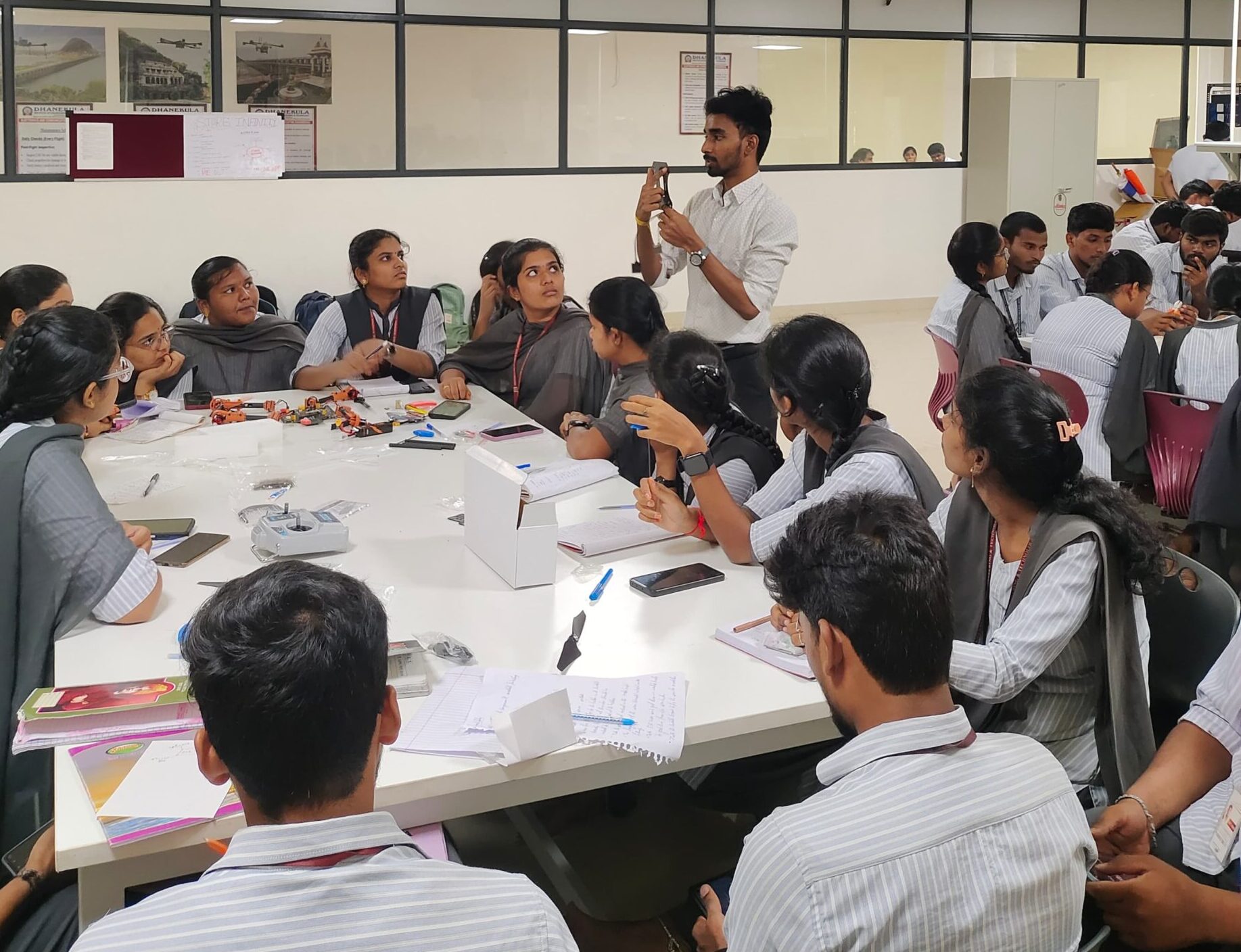
When our team conducted a 3-day drone training workshop at Navodaya Institute of Technology in Raichur, we expected enthusiasm. What we got was something more.
Students didn’t just follow instructions. They asked “what if we tried this instead?” They assembled and calibrated their own drones, flew what they had built, and then took on R&D projects, including Raspberry Pi integration and servo control using Arduino and MAVLink. Faculty members were just as engaged, already thinking about how drone technology could be woven into their curriculum and research.
That kind of curiosity doesn’t depend on a postal code. And it’s not a one-off. It’s a pattern we keep seeing wherever hands-on drone learning reaches students who haven’t had it before.
Why Smaller Cities Have a Real Advantage
1. Hunger Beats Access
Students in Tier-2 and Tier-3 cities often have fewer distractions and a stronger drive to prove themselves. Give them the right tools and a clear path, and they tend to outwork expectations.
2. Experimentation Is Cheaper Than You Think
R&D doesn’t need a metro-city budget. A student with a DIY drone kit and curiosity can prototype sensors, test flight behavior, and iterate just as effectively in Raichur as in Bengaluru. Open spaces for flight testing are also easier to find outside crowded cities.
3. Underserved, Not Under-Talented
These colleges haven’t lacked ability. They’ve lacked exposure. The moment structured, hands-on drone education arrives, the gap closes faster than most people expect.
4. Real Problems Right Outside the Classroom
Agriculture, rural logistics, infrastructure inspection, land mapping, disaster response: smaller regions are surrounded by exactly the challenges drones are built to solve. Students who understand these problems firsthand are better placed to build practical solutions.
What It Takes to Unlock This Potential
Talent alone isn’t enough. For Tier-2 and Tier-3 colleges to become genuine innovation hubs, three things need to come together:
- Structured curriculum. Not one-off demos, but progressive programs that take students from basics to R&D.
- Hands-on tools. Students need to build a drone themselves, not just watch someone else do it. A beginner-friendly DIY drone kit makes that possible without prior experience.
- Faculty enablement. When teachers are trained alongside students, drone skills stay on campus long after the workshop ends.
This is the model we follow at Dronacharya Tech Hub: bring complete drone training programs, from first assembly to advanced integration, directly to institutions that deserve access to them.
The Opportunity Ahead
India’s drone sector is growing across agriculture, defense, logistics, mapping, and surveillance, and every one of those industries will need skilled people who can build, program, and fly UAVs. That talent won’t come from five cities alone. It will come from hundreds of campuses across the country, including many that rarely make headlines.
The next breakthrough in drone technology may not come from where everyone is looking. It may come from a classroom in a smaller city, from a student who built their first drone last month.
Bring Drone Education to Your Campus
If you’re a decision-maker, HOD, or faculty member at an institution that wants to introduce hands-on drone education, a drone workshop, or a full drone kit based curriculum, Dronacharya Tech Hub is ready to partner with you. Reach out to us for a free consultation and let’s build your campus’s first drone innovation lab together.