
A few years ago, a career in drones was something most people could not have mapped out clearly. The industry existed, but the roles were scattered, the pathways were unclear, and the skills required were largely self-taught. That has changed significantly. Today, drone technology is one of the fastest-growing sectors in engineering and technology, with defined career tracks, growing demand for skilled professionals, and a clear need for people who understand these systems deeply.
If you have been wondering whether a drone career is the right direction for you, this is an honest look at what the field involves, what skills matter most, and what you can realistically expect on the journey.
The industry is larger than most people realise
When people think of drone careers, they often picture someone flying a camera drone for aerial photography. That is one small corner of a much larger picture. Drones are now being used across agriculture, logistics, infrastructure inspection, emergency response, defence, environmental monitoring, construction, and healthcare delivery. Each of these sectors requires people who can design, build, operate, maintain, and develop drone systems and the demand across all of them is growing faster than the available talent pool.
This is not a niche interest anymore. It is an industry, and it is looking for engineers, technicians, software developers, data analysts, trainers, and researchers who understand how drones work and how to put them to work.
What skills actually matter
A drone career does not require one specific background. It draws on a wide range of disciplines, and where you fit will depend on where your existing strengths lie and where you want to develop.
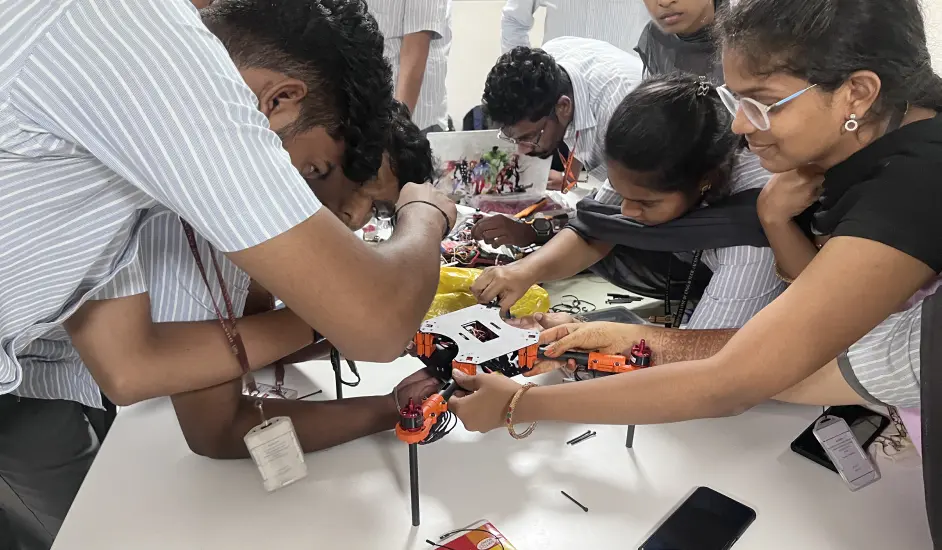
On the hardware side, understanding electronics, embedded systems, and mechanical integration is valuable. Knowing how to read a circuit, configure a flight controller, diagnose a power issue, or assemble and calibrate a drone from components gives you a significant advantage. This is exactly the kind of hands-on knowledge that comes from working in drone labs and building platforms like the Vikas R&D Kit from the ground up.
On the software side, skills in embedded programming, autonomous systems, computer vision, and data processing are increasingly in demand. Drones are becoming more intelligent, and the people who can program and configure that intelligence are among the most sought-after in the field.
Beyond the technical, communication and problem-solving matter enormously. Drone operations rarely go exactly as planned. The ability to think clearly under pressure, document what went wrong, and find a practical solution is something employers notice quickly. R&D environments in particular reward people who can work through uncertainty without losing focus.
The paths into the field
There is no single route into a drone career, but there are a few common one’s worth understanding.
The most direct path is through engineering. Graduates in electronics, mechatronics, aerospace, computer science, or related fields have a strong foundation to build on. The gap for most of them is practical, hands-on experience with actual drone systems, which is where structured programs, drone labs, and kits like the Vikas R&D Kit become genuinely important. Academic knowledge needs to meet applied experience before most employers will consider someone ready.
A second path is through training and certification. Several countries now have formal licensing frameworks for commercial drone operations. Completing certified training, building flight hours, and developing a portfolio of real-world operations is a credible route into roles focused on operations, inspection, and deployment.
A third path, and one that is often underestimated, is through teaching and training. As drone-based learning expands into schools, colleges, and corporate training programs, there is growing demand for people who can run workshops, design curricula, and help others develop drone skills. At Dronacharya Tech Hub, some of our most effective instructors came from technical backgrounds and found that teaching gave their knowledge a new dimension and opened doors they had not expected.
What to expect in the early stages
It is worth being honest about the early part of a drone career, because it is not always what people imagine.
The first thing most people discover is that there is far more to learn than they expected. Drones look simple from the outside. Once you start working with them seriously. In a drone lab, on an R&D project, or during a structured training program, the complexity reveals itself quickly. That is not a reason to be discouraged. It is a reason to approach the field with genuine curiosity and patience.
The second thing is that practical experience matters more than credentials in most hiring decisions. Employers in this space want to know what you have built, what problems you have solved, and how you think when something does not work. A person who has assembled drones from scratch using the Vikas R&D Kit, run flight tests, debugged integration issues, and participated in workshops will almost always be considered more seriously than someone with a qualification but no hands-on background.
The third is that the field moves fast. Drone technology evolves continuously, and a career in this space requires a genuine commitment to keeping up. Regulations change. New platforms emerge. Sensors improve. The people who thrive are those who stay curious and keep learning, not just during training, but throughout their career.
How Dronacharya Tech Hub fits into this
At Dronacharya Tech Hub, we have built our programs around one core belief: that the best preparation for a drone career is not passive study but active, practical engagement with real systems. Our drone labs are designed for exactly that. Whether you are working on a drone platform for the first time, participating in an advanced R&D project, or attending one of our specialised workshops, the experience is structured to develop the kind of skills that actually matter in the field.
We have seen students with no prior experience go on to work in drone operations, manufacturing, inspection, and research. We have seen working engineers use our programs to shift into drone-focused roles. And we have seen curious hobbyists discover that what started as an interest had the depth to become a real career.
So is it right for you?
A drone career suits people who enjoy working with technology at a practical level, who are comfortable with the idea that learning never really stops, and who want to be part of a field that is still being shaped. If you like solving problems with your hands as much as with your mind, if you are drawn to systems that require you to understand how every part connects to every other part, and if you find the intersection of hardware, software, and real-world application genuinely exciting, then yes this field is probably worth exploring seriously.
The drone industry is not waiting for the right moment to grow. It is already growing. The question is whether you will be part of that growth, and what kind of foundation you will build to get there.