
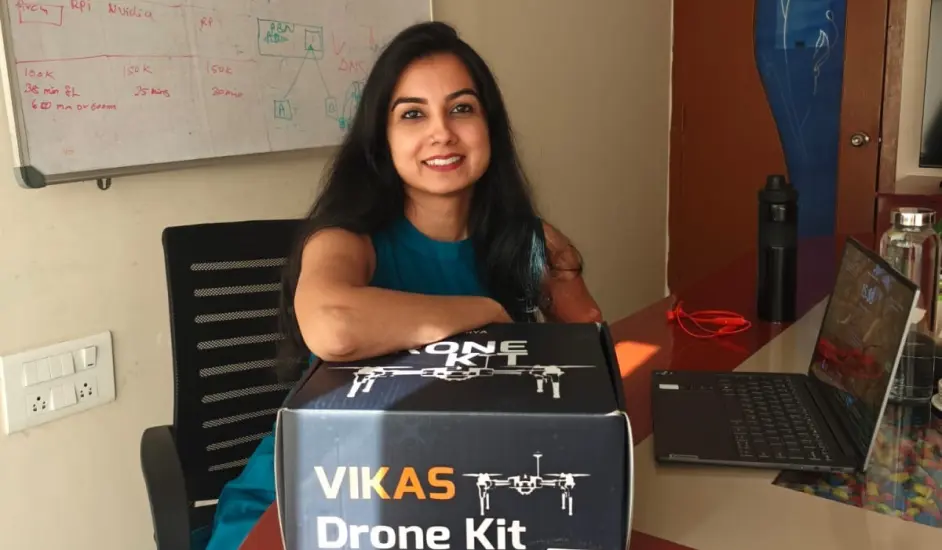
My journey into drones did not begin with a drone.
It began with computer science.
As a computer science engineer, I started my career in technology, building an understanding of how systems work, how problems can be broken down, and how technology can be used to create practical solutions. Over the years, my professional journey evolved across business development, relationship management, technology-led solutions and B2B engagement.
Today, I find myself working at an interesting intersection: emerging technology, industry and academia.
And perhaps what makes this journey particularly exciting is that drones are not just another technology I work with. They have become a lens through which I see a much larger opportunity – how we can make education more practical, interdisciplinary and closely aligned with the way technology is actually evolving in industry.
From Technology to Application
Drones are often perceived simply as flying machines.
But spend a little more time with the technology and that perception changes quickly.
A drone brings together electronics, embedded systems, communication, sensors, control systems, aerodynamics, programming, artificial intelligence, data and increasingly, autonomous systems. More importantly, it gives students something that traditional classroom learning sometimes struggles to provide: a physical system on which they can experiment, fail, troubleshoot and build again.
That is where my work with institutional partners has become particularly meaningful.
Working with universities and engineering institutions, I have increasingly found myself asking a question beyond “How do we deploy this technology?”
The more important question is:
“How do we make this technology meaningful in the learning journey?”
That requires us to think beyond hardware procurement.
A drone lab, for example, should not simply be a room with a few drones sitting on a shelf. It should become an environment where students can understand UAV engineering through hands-on experimentation, projects and problem-solving.
That means combining the right hardware with curriculum, faculty enablement, training methodologies, technical support and a pathway for students to move from fundamentals to advanced applications.
Building the Industry-Academia Bridge
This is where my role has evolved significantly.
Today, a large part of my work involves creating partnerships between technology providers, educational institutions and the wider ecosystem around them.
The objective is simple: reduce the gap between what students learn and what industry increasingly expects them to understand.
But I have also realised that this bridge cannot be built by institutions and technology companies alone.
It needs an ecosystem.
And that led me to another important part of my current work – building a network of channel and ecosystem partners who can take drone education to a much wider audience.
Enabling Traditional Businesses to Enter Emerging Technology
One of the most interesting developments I have seen is the growing interest from businesses that traditionally operated outside the drone ecosystem.
For example, there are established laboratory equipment suppliers who already have strong relationships with universities and engineering colleges. Their expertise lies in understanding institutional procurement, academic requirements and laboratory infrastructure.
For them, drones represent an opportunity to expand their portfolio into an emerging technology category.
Similarly, we work with skill-development centres and education businesses that have traditionally offered programs in STEM, robotics, AI, Python, coding, project-based learning, internships and job-oriented technical training.
These organisations already understand how to engage students.
What they often need is the technology ecosystem and academic framework to enter Drone education.
That is where a partnership-led model becomes powerful.
Instead of simply selling a drone kit, we can enable a partner with a model drone lab and a turnkey Drone education solution – the appropriate hardware configuration, hands-on learning infrastructure, curriculum, technical training, faculty enablement and support required to deliver both short-duration workshops and longer-duration Drone engineering programs.
The idea is to enable them to become a credible drone education and skilling provider. Because scaling emerging technology education is not only about building more products. It is about building more capable ecosystems around those products for easy adaptation.
Why K-12 Education Excites Me
Another area that has increasingly captured my attention is K-12 education.
And perhaps my perspective here is more personal.
I strongly believe that the younger the learner, the more naturally curious they tend to be.
Children don’t hesitate to ask why.
Why is the drone flying?
Why does it tilt?
Why doesn’t it fall?
How does it know where to go?
Can we make it carry something?
Can we use it to solve a problem?
Those questions may sound simple, but they represent something incredibly valuable: problem-solving curiosity.
And that is exactly the kind of conversation I believe technology should initiate in education. We should not introduce drones to children merely to teach them how to operate a drone. We should introduce technology to encourage them to look at a real-world problem and ask:
“Can I build something that solves this?”
That shift – from consuming technology to understanding and creating with technology – is fundamental to building future-ready learners.
Being a Technologist and a Parent
This is also where my personal experience as a mother influences how I think about education.
At home, I am constantly answering questions from my son. Sometimes the questions are easy. Sometimes they lead me down a rabbit hole where I realise I need to think about something myself before I can explain it.
But there is one thing children consistently remind us of: complexity is often created by the way we explain something, not necessarily by the technology itself.
That has influenced the way I approach academic engagement.
When we work with faculty, the objective cannot simply be to introduce another sophisticated technology and expect them to immediately translate it into classroom learning. We need to demonstrate how the technology works, why it matters, how it can be taught, and how students can ultimately apply it.
The Bigger Vision
My journey from computer science to drones was never really about changing technologies.
It has been about continuously moving closer to technology that solves real problems.
Today, my work sits at the intersection of emerging technology, academic partnerships, business development and ecosystem building.
Whether it is helping a university establish a UAV innovation lab, enabling a traditional laboratory supplier to enter drone education, helping a skill-development centre add hands-on UAV engineering programs, or thinking about how a school student can begin exploring autonomous technology – the underlying objective remains the same.
Make technology accessible. Make learning experiential. And make education relevant to the problems of the real world.
The future of emerging technology education will not be built by one company, one institution or one technology.
It will be built through collaboration – between industry and academia, educators and technologists, parents and learners, manufacturers and ecosystem partners.
And I believe my own journey is still evolving.
I started by understanding technology through the lens of computer science.
Today, I am learning to understand technology through the lens of people, education and possibilities.
And perhaps that is the most exciting part of working with emerging technology: The technology keeps changing. So do we.